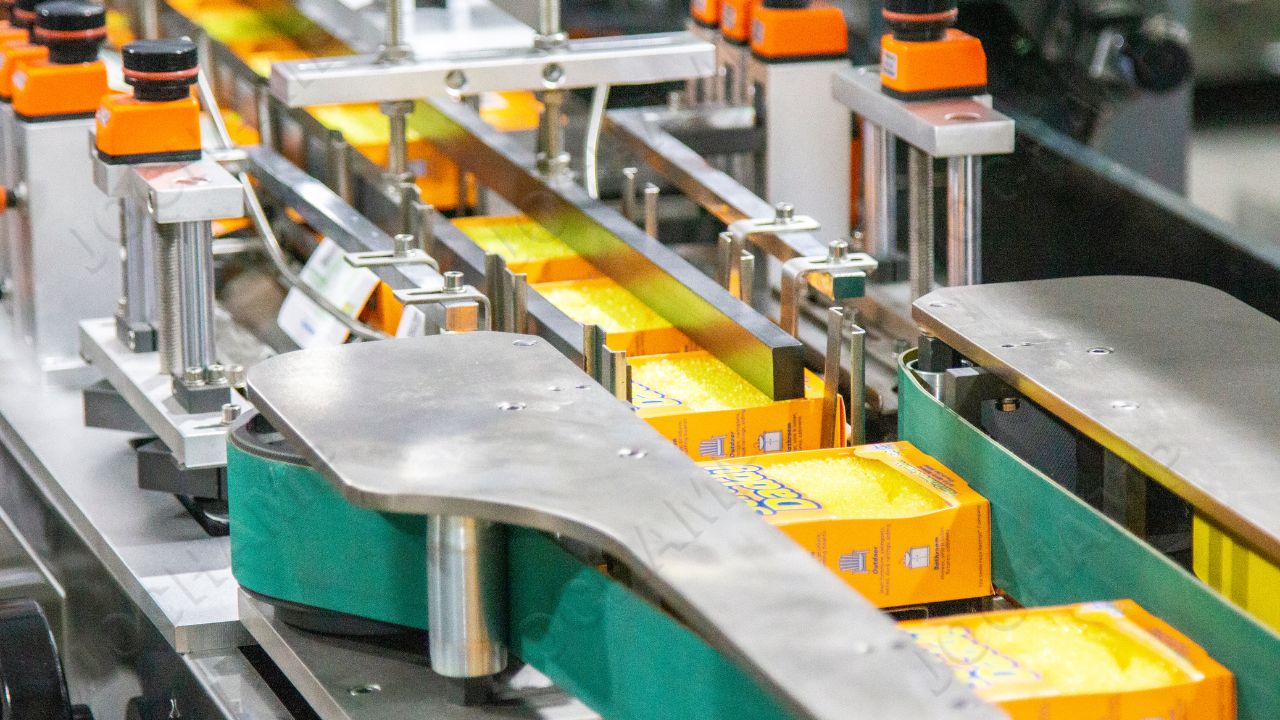
Cartoning machines are the backbone of any production line. Achieving higher operational efficiency requires your staff to master how the cartoning machine works.
With an in-depth knowledge of the cartoning machine working principle, your team can optimize the packaging process and develop rapid troubleshooting skills. This knowledge is critical in reducing costly downtime.
In this article, we will start by exploring the basic cartoning machine parts, then explore how each technology works.
What is a Cartoning Machine?
A cartoning machine is an automated packaging system that forms, fills, and seals cartons. These machines play an integral role in many production lines as either primary or secondary packaging solutions.
When fully integrated with the product’s infeed synchronization mechanism, it offers seamless, fast, and error-free packaging. Of course, this also works hand-in-hand with improved changeover efficiency, allowing you to package different products in varying carton sizes.
Now, to fully understand the working principle of a cartoning machine, it will be best to know the various components that make up this system. The table below summarizes the key components that help in automatic cartoning machine operation:
| Parts of Cartoning Machines | Function |
| Magazine | · Ensures smooth supply and prevents jamming
· Holds a flat carton and feeds it into the machine. |
| Vacuum Cups | · Lifts cartons from the product while on the conveyor and places them into the correct position. |
| Blow-off Nozzles | · Acts as carton separation and carton opening
· Removes dust and debris |
| Erection Fingers/Tuckers | · Open and fold carton flaps |
| Product infeed/Conveyor System | · Introduces the product into the erected cartons and various filling stations |
| Product loading ram | · Plays a major role in product insertion and accurate placement |
| Flight chains/indexing screws | · Move the cartons along the machine while also helping to maintain spacing |
| Stabilizer guides | · It helps to keep the carton stable, thus preventing any tilting, ensuring smooth movement |
| Product feeding system | · Maintains a continuous and steady flow of product and ensures proper product spacing. |
| Glue applicators | · Responsible for applying glue to cartons’ flaps to secure the carton, which acts as product protection and ensures the carton remains sealed |
| Compression units | · It helps to maintain the correct carton shape while the glue sets, applying pressure on the glued carton. |
| Code dating/printing unit | · It prints the cartons with vital information like manufacturing date, expiry date, batch number, or any other information that helps in product identification |
| Electronic camming system | · It controls the timing of the cartoning machine |
| Programmable logic controllers | · Logic controllers, through the help of PLC software, automatically control various operations of the carton packaging process |
| No carton, no product sensors | · Special sensors that detect whether the cartons and products are present for a fully automatic and seamless process |
| Jam detectors | · It protects the machine from damage by detecting both product and carton jams, thereby preventing wastage |
| Safety Interlocks | · Prevents accidental startups and protects operators. |
Key Working Principle of Cartoning Machine
The automatic cartoning machine operation involves a series of operations. Usually, the sequence of carton filling and sealing mechanisms may vary slightly according to the type of cartoner equipment.
These may range from carton pick and place mechanisms, product insertion process, to leaflet insertion systems, among others.
Step 1: Setting Up Carton (Blank Erecting)
For a carton machine to work properly, the first step is to ensure you set up your carton properly. This involves several processes, such as adjusting the carton magazine to help ensure cartons are correctly positioned for easy pickups.
Secondly, it is to set the vacuum suction cups to help separate and transfer a single carton blank.
Thirdly, ensure you adjust the cartoning opening mechanism by adjusting its opening arms and mechanical fingers. This usually helps ensure the cartons open fully without tearing.
The fourth step is to align the transport lugs spacing according to the carton length. This process helps to ensure the carton’s stability is maintained during movement. Additionally, set the carton stabilizer guide to help maintain the correct carton position.
Also, you should ensure you test the carton erecting process by checking proper carton pickups and full opening of the carton, no double blank feeding.
Lastly, you should test the sensor calibration to prevent machine errors and product loss.
Step 2: Filling Carton or Product Loading
In this stage, the product is inserted into the erected carton before the carton is closed or sealed.
First, the product is delivered or moved to the cartoning machine using a product feeding system, such as conveyors or hoppers. It then moves to the next step, which is the carton positioning, where the erected cartons move along the machine on transport lugs or flights.
It is a critical step that ensures that the carton remains properly aligned for loading.
At this stage, a product loading ram inserts the product into the open carton without causing any damage. It is later pushed into the sensor verification to check for various things, like the correct number of items, and if the carton is present.
When you look at most carton packaging machines available in the market, their configurations may vary slightly.
Let’s explain some of the most common options:
· Based on the Motion
Ideally, you will find continuous cartoning machines and intermittent cartoning machines. With these machines, the only differentiating factor is the movement of the cartons.
That is, for continuous motion cartoning machines, cartons will move without stopping during the packaging process.
On the other hand, for intermittent motion cartoning machines, the packaging process moves along the conveyor system, while stopping at specific stations. Now, as the packaging stops in specific stations, the machine may perform a wide range of operations, which may include loading, sealing, etc.
· Loading Orientation
In most cases, you will find either a horizontal cartoning machine or a vertical cartoning machine.
Horizontal cartoning machines are suitable for sturdy items like pizzas or blister packs. The working principle of these machines involves using a mechanical pusher to move products horizontally into the packaging box.
That is, the cartons in horizontal machines will be in a “lying position”.
On the other hand, vertical cartoning machines are a perfect choice for loose products such as granules or fragile items. To package items in boxes, these machines use a pick-and-place mechanism or a gravity-assisted technique. That is, the box will remain in an upright position, after which the product will be lowered into the carton.
· Load Direction
For this classification, your focus will be on the product entry point. That is, you will have:
- Side-load cartoning machines: These are mostly common in horizontal cartoning machines. Here, your items enter the packaging box from the side.
- Bottom-load cartoning machine: These are specialized carton packaging machines. Your machine can either lower the carton into a product, or the product will be lifted underneath the box.
- Top-load cartoning machine: You can find this technology in vertical cartoning machines or hybrid systems. That is, the machine will place products on the box or load from the top.
Now, once the product is loaded, the carton moves to the closing section where the flaps are sealed.
Step 3: Sealing Carton/Closing Carton
At this point, the machine automatically folds the carton flaps into position. Different methods are used in this stage to help secure the carton depending on the product and the type of packaging requirement.
Some of the most common techniques you can use include:
- Adhesive sealing or hot melt glue technology– suitable for high-speed production and for tamper-evident packaging.
- Tuck-in closing– It is common in the cosmetic industry. The machine uses a simple tuck or a locking tuck to secure the products. That is, the machine folds and pushes the extended tuck into the box.
- Pressure-sensitive tape– The machine will apply a strip of adhesive tape across the box seam.
- Cold glue sealing– It uses a water-based adhesive to seal cartons.
- Heat sealing method– This is a common sealing technique in the food and beverage industry. Cartoning machines with this technology use a heating element that melts a thin layer of wax or plastic. It melts and then fuses them to form a seal.
The carton is then sealed either by using glue applications or flap insertion. The carton is then printed or coded with a batch number, manufacturing date, and expiry date. It later undergoes inspection to check if the carton is properly closed and if the glues applied correctly, and later the carton is discarded.
Step 4: Discharging Closed Carton
This is usually the final stage where, after sealing, the cartons are moved by using flights or transport lugs to the conveyor.
The cartons are then aligned to help maintain proper orientation for the further packaging process. It is later moved to the final stage, where it undergoes inspection to ensure only correctly packed cartons proceed to the next stage.
Advanced Technologies in Cartoning Process
· IoT and AI Integration
This is a type of technology in the cartoning process that helps to contribute to and create a smart and more efficient packaging system. IoT helps connect cartoning machines to a digital network, whereby sensors, controllers, and software systems can easily communicate with each other.
On the other hand, AI integration uses the collected data to make intelligent decisions, thus improving the cartoning process automatically.
· Leaflet Insertion
Leaflet insertion helps to ensure important information is captured and included in the package for consumers. Additionally, it also helps to improve packaging speed and efficiency.
· Code Verification & Inspection
Code verification and inspection is an advanced carton technology that ensures that the printed information on the carton is correct, thus ensuring correct product identification.
· Quick Changeover
Quick changeover normally plays a major role in helping the manufacturer to adapt production lines quickly when switching between different products, designs, and packaging sizes.
· Automation Software
Automation software is used to monitor, control, and manage the operation of the cartoning machine. It also helps to detect faults and trigger alarms.
Although most machines use the PLC system, recently these machines have adopted advanced systems that use AI to increase productivity.
FAQs
1. Can one machine handle multiple carton sizes?
One cartoning machine can handle multiple carton sizes depending on the machine design and adjustment features.
2. What is the “No product, No carton” feature in the cartoning process?
This is usually a control system that helps prevent a carton from being formed.
3. Which is the best closure method for cartons?
The best closure method for a carton is a tuck-in flap closure.
4. Do cartoning machines insert leaflets automatically?
Yes. Most cartoning machines are known to insert leaflets automatically.
5. What causes carton jams?
Carton jams are caused by different reasons, such as incorrect carton size, improper machine adjustment, product feeding problems, sensor or control system failure, poor maintenance, and incorrect carton erection.
6. What is the difference between case packing machines and cartoning machines?
A case packaging machine can pack multiple products/ cartons into one large shipping case, while a cartoning machine can only place one product into small cartons.
7. How do glue-top vs. tuck-in closure methods compare?
Glue top has a seal strength that is strong and permanent, while the tuck-in closure seal strength is moderate.
The glue top cannot be easily opened during handling, while the tuck-in closure is likely to open during handling, most especially when it is heavy.
8. What is the benefit of a sensor-based rejection system in the cartoning process?
Sensor-based rejection system helps to detect problems like missing leaflets, open or improperly closed cartons, and remove detects
9. Can you integrate cartoning machines with blister packaging?
Yes. A cartoning machine can be integrated with a blister packaging machine to create a fully automated packaging line.
10. How can you improve the cartoning machine efficiency?
There are several ways for you to improve your cartoning machine’s efficiency, such as;
proper machine maintenance, correct machine adjustment, train machine operators, reduce change over time, use a sensor and control system.
11. What are the most common cartoning machine synchronization issues?
The most common cartoning machine synchronization issues include. Product and carton timing mismatch, leaflets and product synchronization problems, glue application timing errors, and sensor PLC timing errors.
Partner with Neocarton
Neocarton is among the leading cartoning machine manufacturers in China. At Neocarton, we design and manufacture a wide range of cartoning machines, which you can easily integrate into your production line.
Our machines are tested to comply with the internationally accepted safety standards. Whether you are in the pharmaceutical, food processing, or chemicals industry, Neocarton has a perfect solution for you – Get a quote now.