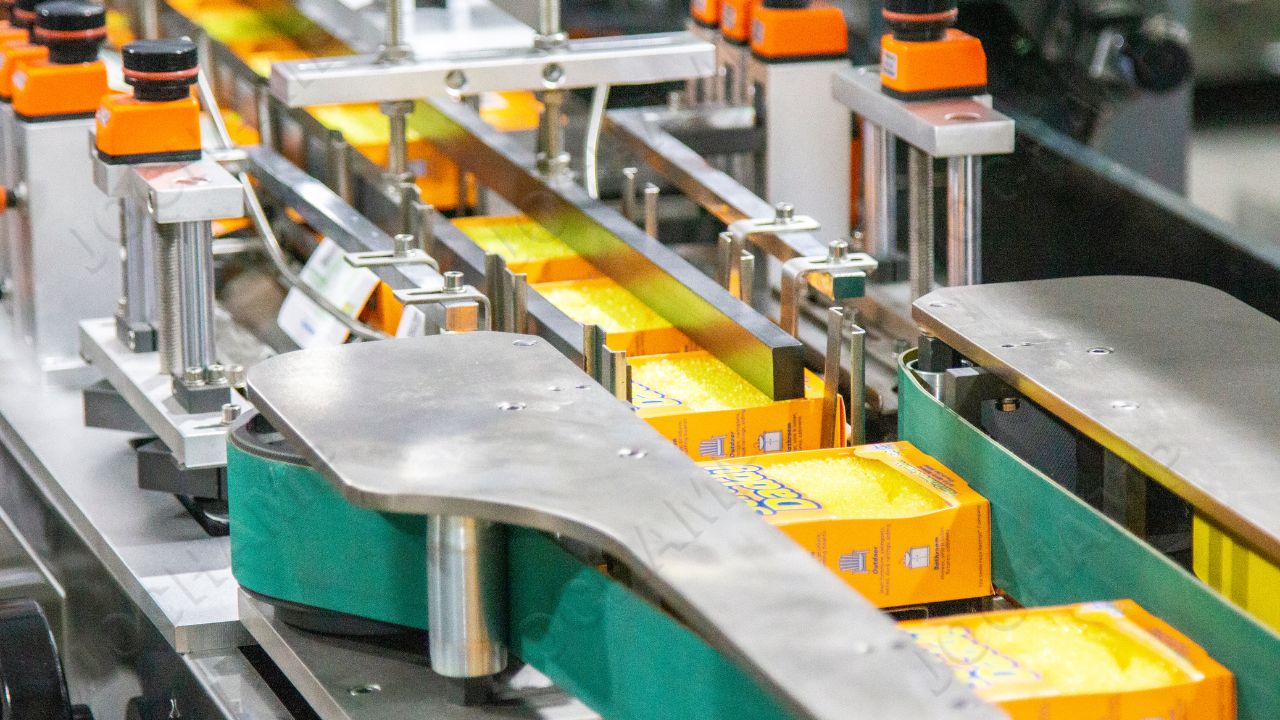
Whether you are in consumer goods, or food and beverage industries, you probably need an efficient end-of-line packaging solution. That is exactly where case packer machines come in.
By integrating these machines into your production line, your factory will eliminate labor constraints, and reduce material wastage, for a higher ROI.
This guide breaks down all the critical aspects about case packing system – from basics, working principle to practical applications.
What is a Case Packing Machine?

A case packing machine is an end-of-line packaging equipment. It is specially designed to package products into cases of corrugated cardboard ready for shipping.
These automated performance machines are precise, fast, and consistent, replacing the tedious manual packing tasks.
How Case Packer Machine Works
The working principle of case packer machines involves series of processes that are integrated to follow specific sequence. Usually, the machine achieved this using different parts and components.
Key Components
| Main Part | Function |
| Infeed conveyor | · The conveyor uses sensors to detect product This prepares the products ready for grouping and packing from the upstream production line into the machine. |
| Case magazine | · The case magazine is designed to reduce human labor. During loading, they store blank flat corrugated cases while continuously feeding one at a time into the erecting station. |
| Erecting station | · The station opens each blank flat case and then folds them into a square, rigid, open-top box ready to receive your products. |
| Product accumulator | · These are temporary storage areas in the production line before the loading process. They carefully collect and arrange the products into a pattern for easy movement, ensuring traceability and continuous operation. |
| Loading mechanism | · This component picks, arranges, and places the products into the erected case while preventing damage and risks during the process. |
| Sealing head | · The sealing head closes and secures all open flaps on the filled case firmly using tape or hot-melt glue. |
| Discharge conveyor | · Depending on your discharge point, you can either use a vertical or horizontal conveyor to automatically transport final products out of the packaging station. |
Key Steps in Case Packer Working Principle
Step 1: Case Erecting
The moment you load flat corrugated blanks into the magazine, the machine picks a single flat blank to start the case packing process.
Next, the suction cups grip the blank and force it open while mechanical arms fold the side and bottom flaps into a square box.
Then the hot-melt glue shot locks the bottom flaps, providing the case with strength. This also ensures all corners are perfectly aligned and rigid to hold your product before conveying it to the loading station.
Step 2: Product Loading

As soon as the case arrives from the erection station on a conveyor belt, the products are detected and guided into one organized file.
At the accumulator, the counting and arranging of the products takes place in the correct packing pattern, whether upright, on their side, or layered, before they are released.
When the cases are ready to receive the products, the loading mechanism takes and transfers them, usually by a drop-load system, mechanical pusher, or robotic arm.
Step 3: Case Closing
After products are loaded, and the end-of-line packing receives the conveyed filled cases, the sensors precisely position the flaps for sealing.
Your choice of sealing will depend fully on the design and type of production. For high-speed and mass production, use hot-melt adhesive to apply to each flap for a durable bond tamper-evident closure.
For lighter and slower products that require easy opening, running pressure-sensitive tape seal at the top flaps works best.
Then, pass through the machine for consistency checks and complete closure of each case before releasing to the next stage.
Types of Case Packer Machines
Top Load Case Packers
Top load case packers are the most common smart packing automation machines that erect an open RSC (Regular Slotted Container) case and vertically load products using a pusher, drop mechanism, or robotic arm from the top.
Advantages:
- They are very flexible machines that work with upright, delicate, and unique-shaped items. This is as long as they can be loaded from the top, such as jars, cans, upright bottles, and tubs.
- They fit easily into existing automated packaging line setups.
Limitations:
- Due to their type of loading and complex mechanical design, they usually run at lower speeds compared to wraparound case packers.
Side Load Case Packers
Side-load case packers can be used as an option by the manufacturer; they occupy less space and ensure efficiency and easy processes of secondary packaging.
These are wide, flat item loading machines that load the products horizontally in a pre-assembled case by pushing or sliding them in with a side opening.
Advantages:
- These machines are safety-conscious of your product with a gentle loading process.
- They occupy less space in your facility, yet they are also highly stable in supporting your delicate products.
Limitations:

- Its limitation is that it only loads products horizontally. Before loading products, you must take time to position products correctly to prevent damages due to the unique design of the machine.
Wrap-Around Case Packers
Wrap-around case packers are small and compact machines that use minimal material and provide high accuracy.
They apply flat die-cut cardboards in the food industry primarily to secure products that are to be retailed safely.
Advantages:
- The wrapping is quite tight and stable, guaranteeing the safety of the goods and high pallet density.
- Their simple operations, packability, and speed of operation make them perfect in high-volume lines.
Limitations:
- They are not so flexible in packing; they can only be trusted with hard and normal shapes, but not fragile items.
- They are designed to appear simple, yet they are the costliest machines to install when compared to other common case packers.
Robotic Case Packers
These automated packaging systems are operated by sensors and cameras to retrieve and fill goods into containers with delta, gantry, or six-axis robotic arm technology.
Advantages:
- It is a fast and highly versatile operation that can run numerous SKUs and packing patterns without the need to retool, thereby enhancing throughput.
- They are the most sensitive when it comes to the handling of delicate products, which incorporates AI vision smart packing automation to provide real-time orientation of the product and quality inspections.
Limitations:
- The price of purchasing and installing a robotic case packer is more expensive than that of the usual mechanical case packers.
- Maintenance is also very expensive since you need technicians who are proficient in programming, maintenance, and troubleshooting.
Key Industries That Use Case Packer Machines

· Food and Beverage
This happens to be one of the best industries in the manufacturing process, where case packers are used in filling products, sealing, and packing cartons and bottled beverages.
· Pharmaceutical
When working in the pharmaceutical industry, accuracy during packaging and adherence during handling are the most essential. Case packers ensure that your products are handled and packed properly with minimal human contact to avoid contamination.
This is different from manual packaging, where employees are involved directly with the items during filling, sealing, and carrying processes.
· Consumer Goods
Consumer goods like detergent bottles, personal care products, and home cleaners are goods that are bought in bulk across the globe.
Top loader case packers are more adaptable and quicker to handle large quantities, thereby meeting the rising demand of the customers.
· E-Commerce and Logistics
The slowing down of logistics departments in most industries is caused by repetition and error.
The manual labor issue of packing and product confirmation prior to shipment is addressed by automated case packer machines, resulting in the achievement of efficient, fast, and low errors in the logistics line, therefore, greater throughput.
Benefits of Case Packer Machines
· Increased Throughput
They address the issue of manual packaging that physically involves employees in filling cartons that may be erratic, slow, and prone to errors by placing precision, reliability, and speed machines at the end of the packaging line.
· Reduced Labor Costs
The advantages of investing in case packers is that it will lower your cost of labor by almost 50 percent by removing repetitious packing tasks that are associated with manual packaging, minimizing material waste, and increase production in the long run.
· Better Product Security
All stages of case packing are automated to treat products delicately and accurately to reduce breakage, crushing, and damage.
· Meeting Packaging Standards

Always check whether the machine is in accordance with the standards and regulations to ensure efficiency in production before investing in it.
Provided that you purchase them from a well-established manufacturer, case packers address the needs of retailers and shippers by providing consistent uniformity in their weights, sizes, and designs of cases.
· Packaging Efficiency
They possess the highest-quality precision and changeover systems that automatically reduce wastage and consequently maximize production.
Selection of the correct equipment to use in packaging
How to Choose the Right Packaging Equipment
· Production Volume
Know your production line, space, speed, and efficiency to help you in choosing appropriate equipment for your facility.
· Product Type
When deciding on the right equipment for your products, always consider factors that protect your items, such as shape, degree of fragility, weight, and product orientation.
· Changeover
Choose a machine with a fast and tool-free changeover for your end-of-line production. When running multiple SKUs, you will reduce performance downtime and keep production schedules on track.
· Space Constraints
Before you make a decision on the size and type of machine to invest in, measure the floor space and select a machine that fits your line without disrupting existing workflows.
· Semi-Automatic vs. Fully Automated Systems
Semi-automatic machines are the best choice for lower volumes and budget-conscious operations, while fully automated systems maximize output for high-volume manufacturing.
· AI and IoT Integration
Case packer machine manufacturers are integrating Internet of Things (IoT) and Artificial Intelligence (AI), which offer robust data analytics and smart packaging solutions.
Among the key implementations are the IoT-enabled sensors, and AI powered optimization strategies. They help in predictive maintenance, remote diagnosis, quality control and self-tuning.
· Sustainable Packaging Solutions

When investing in your industry equipment, choose a durable and efficient automated packaging solution that can handle recycled corrugated materials and ESG commitments in production by minimizing glue usage.
· After-Sales Support
Always partner with the best manufacturers of case packer machines and packaging equipment supplier who can offer training, spare parts availability, remote support, and preventive maintenance programs for long-term investment protection.
Troubleshooting Case Packaging Systems
| Problem | Possible Cause | Recommended Solution |
| Cases not squaring | · Inaccurate case blank dimensions | · Check the exact settings in the machine or the manufacturer’s manual and verify if they match the dimensions of the case blank. |
| Suction failure | · blocked vacuum lines | · Use compressed air to carefully clear any blockages in vacuum lines. |
| Poor glue adhesion | · Low glue temperatures | · Always verify the machine manufacturer’s manual for the operating range and raise the glue temperature. |
| Crushed product | · Use of excessive force while loading | · Use servo control technology to reduce pusher or drop speed at the loading station. |
| Double feeding | · worn separator fingers | · Inspect for worn-out separator fingers that no longer isolate individual blanks and then replace them. |
| Frequent jams | · Machine frame with debris inside | · You must make inspection and cleaning a daily routine at the production line to prevent debris from building up inside the frames. |
| Inconsistent Case Flap Folding | · A worn-out folding plow | · Inspect and replace components of the folding plow that are bent or worn out. |
| Photoelectric Sensor Misread | · Due to a dirty sensor lens | · Sensor lenses are very delicate, so to clean, use smooth materials, such as a lint-free cloth and an optical cleaner |
| Machine Stops Mid-Cycle | · A triggered safety guard | · Do a machine inspection to ensure all the safety guards are closed and locked correctly. |
| Tape Wrinkles or Poor Tape Adhesion | · Dusty case flap surfaces | · Wipe and clean the surfaces to ensure you remove traces of dust, oil, or any trapped moisture, and dry the place before wrapping or taping a product. |
FAQs
1. What is the difference between case packers and cartoning machines?
A cartoning machine is a packaging system that uses a paperboard folded carton form to pack products.
Case packers, on the other hand, group those filled and sealed cartons or products into larger corrugated shipping cases in preparation for distribution.
2. How do case packers improve efficiency and consistency?

A continuous cycle case packer system automates product grouping, case erecting, loading, and sealing, to improve efficiency by eliminating human error and delivering uniform case quality at high speeds.
3. What is the typical speed of case packer?
When we mention a case packer, we are literally thinking of the automation speed, which depends mainly on the product type and configuration.
Standard case packers run between 15 and 40 cases per minute, while high-speed robotic models achieve roughly 60 to 85 cases per minute.
4. What is the difference between case packer and palletizer?
Contrary to a palletizer machine, which arranges and stacks sealed cases safely onto pallets in a structured pattern, ready for storage in the warehouse or transportation, a case packer is a product loader that seals and arranges items into display boxes or corrugated shipping cases.
5. How much does a case packer cost?
The cost depends entirely on the speed and complexity of the machine, $20,000 for entry-level semi-automatic models.
Automated models range from $80,000 to $300,000 and above, with robotic case packers at the end.
Neocarton; Your Trusted Packaging Machines Manufacturer in China
Neocarton designs and manufactures a wide range of packaging solutions like cartoners and case packers. Our automated packaging machines feature PLC systems, with robust structure and easy to integrate design with your existing production line.
If you are looking for a case packer machine manufacturer in China, then Neocarton is your trusted partner – contact us for free consultation.