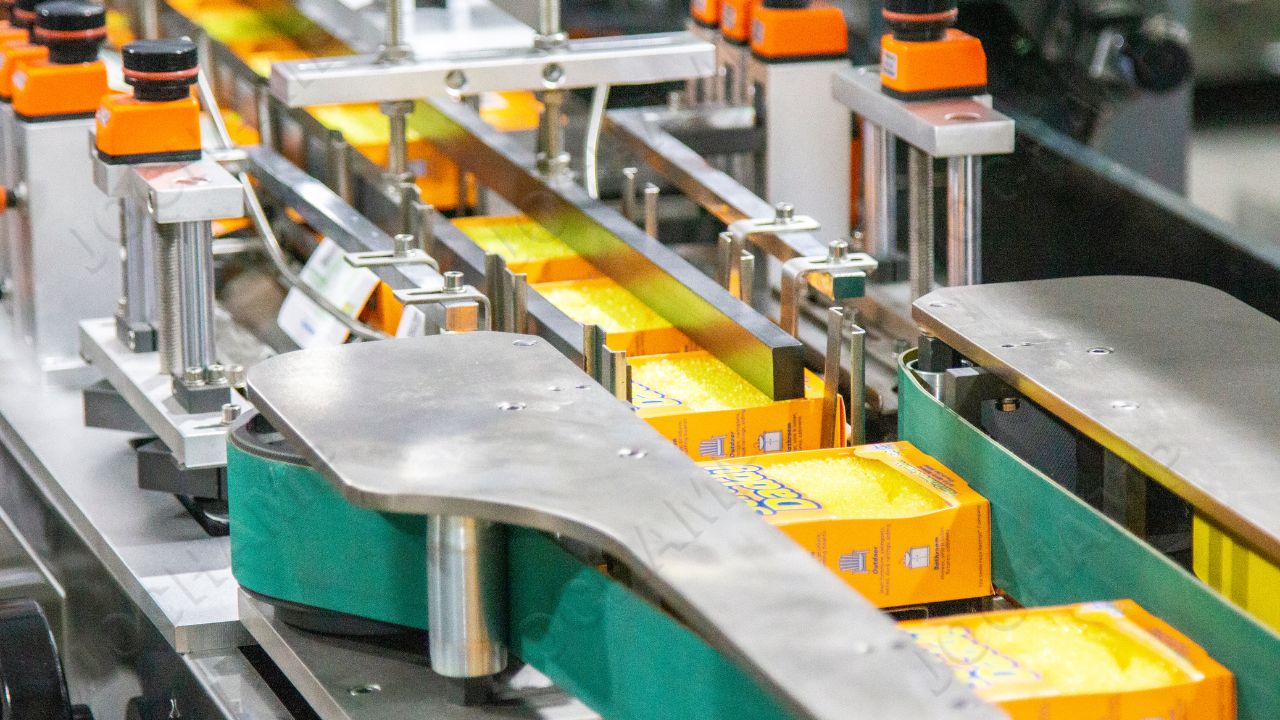
Before you invest in any cartoning machine, it is critical to have strategies that will help your production line achieve higher overall equipment effectiveness and throughput. One of the key variables you must consider is the cartoner cycle time.
By calculating and optimizing cycle time, you will reduce downtime and maximize output, which will definitely guarantee higher ROI.
Cartoning Machine Basics
A cartoning machine is packaging equipment, specially engineered to form, fill and seal cartons. They form a critical component in the production line as secondary packaging solutions.
Cartoners play critical roles in the pharmaceutical, cosmetics, consumer goods, electronics and food industries.
Broadly, you can choose either horizontal cartoners or vertical cartoners.
Horizontal cartoners load products horizontally or from the sides. In most cases, they are suitable for packaging blister packs, bottles or tubes. On the other hand, vertical cartoners load products vertically or from the top. They are perfect packaging machines for free-flowing or granular products.
Furthermore, it is important to note that these machines operate in two distinct motions – continuous motion or intermittent motion.
That is, for continuous motion, the machine forms, fills and seals the machine without stopping. Therefore, these machines are suitable for smooth and high-speed operation.
While for intermittent cartoners, the machine stops at various stages to perform specific operations. These machines are perfect alternatives when you want to have greater control in the packaging process. That is, when you are handling delicate and irregular items.
Understanding Cartoner Cycle Time
A packaging cycle for cartoning machines involves forming, filling and sealing cartons. Therefore, a cartoner cycle time is the duration these machines take to complete a packaging cycle.
Through cycle time, you will determine the number of cartons a machine can produce per minute.
Don’t confuse cartoner cycle time with cartoner speed. The two are inversely proportional.
Calculating Cartoning Machine Cycle Time
The formula for calculating the cycle time of a cartoner machine is:

Therefore, assuming horizontal continuous machines operate at 240 cartons per minute, it implies the cycle time will be 0.25 seconds per carton.
In case the 240 cartons per minute is after accounting for jams, stoppages, and possible inefficiencies, then this is the actual cycle time. However, if this is under “perfect working conditions”, then it is the theoretical cycle time.
Practically, you will hardly find circumstances where the theoretical cycle time is the same as the actual cycle time.
Factors Affecting Cartoner Cycle Time

In real-world conditions, it is advisable to determine cycle time after including the downtime, changeovers, and rejects. Therefore, we can calculate the effective cartoner cycle time as:

This implies the total cycle time is a component of ideal cycle time, setup time, and loss time.
Many variables will ultimately affect this cycle time. These key variables include:
- Cartoning machine design– For instance, continuous cartoners will achieve cycle times faster than intermittent cartoning machines. That is, in intermittent motion machines: Cycle time = index time + dwell time. On the other hand, for continuous motion cartoners: Cycle time = Pitch/Linear speed.
- Integration in production line– A perfect synchronization with upstream or downstream systems can increase cycle time.
- Product characteristics– How quickly the product is loaded in the cartoner is determined by product size, shape, and fragility.
- Machine condition– A well-maintained machine will be efficient, thereby guaranteeing fast machine operation.
- Carton design and material– For instance, thicker cartons require more force to form, erect, and eventually seal.
How to Optimize Cartoner Cycle Time
From our internal R&D, alongside feedback from our clients, it is quite clear that you can easily optimize the cartoning machine’s cycle time. Of course, this involves a wide range of practical measures that include accurate analytical, operational, and mechanical strategies.
Among the proven strategies are:
- Train cartoner operators– With proper training, operators can detect and correct possible mistakes that can reduce the machine’s operating speed.
- Fine-tune machine settings– You must fine-tune the machines to achieve optimal performance. These may include better synchronization, adjusting feed rates, and timing.
- Reduce changeover time– Servo cartoners have reduced changeover time compared to mechanical cartoners. Implementing quick changeover mechanisms and adopting standardized setups will reduce changeover time.
- Adopt automation systems– From PLCs, IoT, and AI to OEE systems, they will help identify inefficiencies and recommend fast corrective measures. This will also go hand in hand with preventive maintenance.
In addition to these, it is critical to work closely with the machine manufacturer who will help you to optimize all operations.
FAQs

1. When can a machine have a high cycle time?
There are specially engineered machines that can have a high cycle time of over 3.0 seconds per carton. These are mainly manual machines or cartoners that handle extremely fragile items.
Additionally, they may have higher dwell times to allow for other processes such as label drying, inkjet coding, etc.
2. What is the difference between cartoning machine cycle time and throughput?
Throughput is the actual output of the cartoning machine, which is expressed as cartons per minute. On the other hand, the cycle time is the time the cartoner takes to complete one cycle of the packaging process.
3. How do you calculate cartoning effectiveness?
Overall equipment effectiveness (OEE) is a critical aspect when determining the overall performance of the machine. The formula is:

Partner with Neocarton

Neocarton is your trusted cartoning machine manufacturer in China. We design and manufacture a wide range of machines, from horizontal cartoners to vertical cartoners.
Depending on your unique packaging requirements, Neocarton offers complete turnkey solutions to match your factory needs – Get a quote now.