Choosing the wrong end-of-line packaging system reduces operational efficiency and drives up costs. As operations manager, you must know when to choose either a case packer or a cartoning machine.
While both systems automate the packaging process, they serve distinct functions in the production line. Therefore, understanding every aspect of these machines will help your factory minimize downtime and attain peak efficiency.
Understanding Case Packers
Case packing machines are critical end-of-line automation systems engineered to package products in larger cases. These systems can package individual or groups of products that are already in cartons into large, corrugated cardboard.
Ideally, these packaging systems play a critical role in tertiary packaging.
Type of Case Packers
· Top-load
In this type of case packer, products are loaded from the top into pre-formed cases or cardboard. The machine can operate either semi-automatically or automatically.
In most cases, these machines are ideal for stable, uniform products like bottles, cans, or cartons, allowing high-speed loading.
Additionally, they support diverse SKUs with minimal adjustments, reducing downtime during changeovers. This also reduces labor, ensuring consistent case integrity and maintaining predictable throughput.
· Side-load
Side-load case packers feed products from the side, often utilizing robotic systems to guide items into cases. These machines are Ideal for packaging delicate products that are difficult to top-load without damage.
They support a range of SKUs without requiring multiple dedicated machines, reducing labor and speeding up production. Depending on product type and machine design, they give high throughput, enabling predictable output and efficient line planning.
· Wrap-around
These automated machines form cases from flat corrugated blanks and wrap the packaging material around the group of products.
They reduce storage requirements for pre-formed cases, lowering costs. Wrap-around case packers support a range of SKUs without needing separate machines for each product type.
They maximize throughput for high-volume production lines, reducing cost per unit and ensuring consistent sealing automation. These machines operate in continuous motion, allowing balance in speed and flexibility to meet your production needs.
· Robotic Case Packer
It is an automated machine that uses an industrial robot to pick, place, and load products into cartons. This packer enables the handling of fragile, irregular, or multiple SKUs on the same line without requiring mechanical adjustments.
They reduce the need for multiple machines dedicated to different products, lowering capital expenditure through customizable stacking patterns.
Robotic case packers enable quick SKU changeovers, minimizing downtime and maximizing line efficiency and throughput
Advantages
For many years, case packing machines have remained popular due to:
- Integration with palletizing systems since you can easily synchronize the machine with the downstream production line
- Flexibility, therefore, you can adjust the machine to handle multiple case sizes with a single machine
- Protects products through consistent packaging
- Packaging speed and efficiency are high due to the fully automated systems, enabling factories to achieve 24/7 operation
Understanding Cartoning Machines
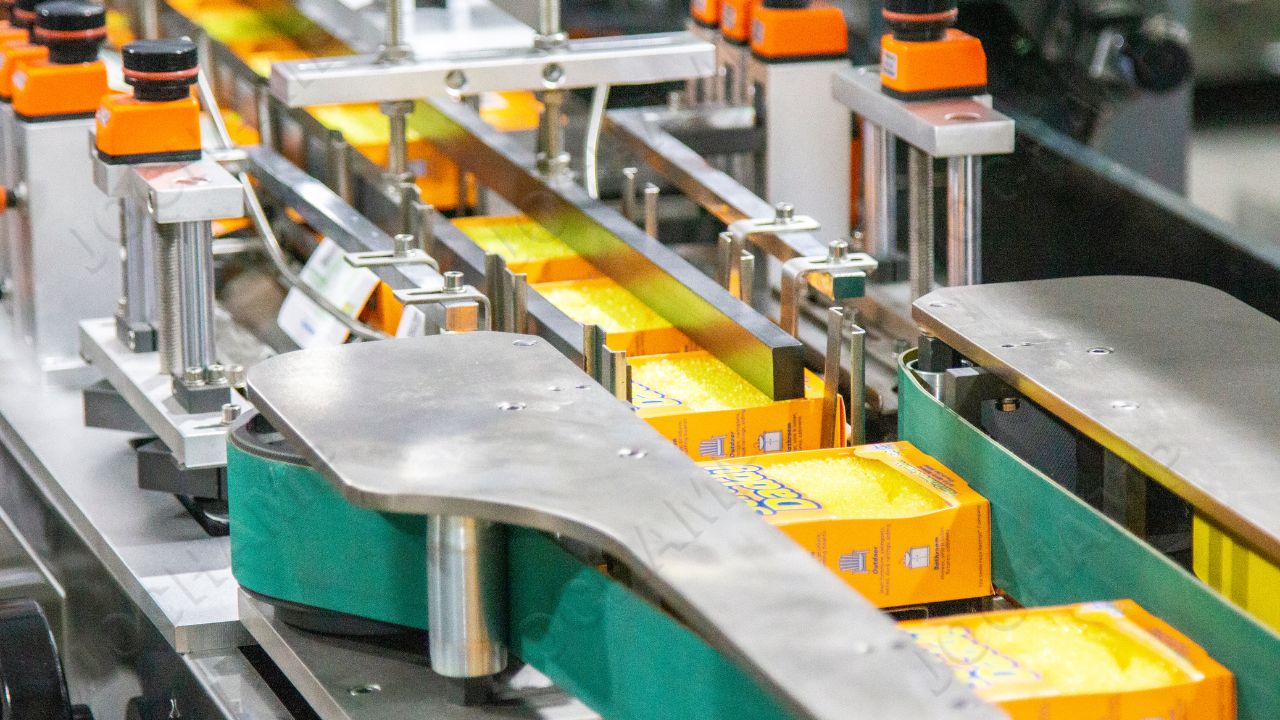
One distinguishing factor between case packers and cartoning machines is the level of packaging in the production line. That is, cartoning machines mainly package products ready to be distributed to customers. On the other hand, the case packer “collects” and puts all products in cartons into a single case ready for shipping.
Therefore, this makes a cartoning machine a secondary packaging solution. That is, their working mechanism involves carton filling and sealing.
In most cases, carton sealing automation involves a wide range of processes, which has actually led to designing a wide range of machines available in the market today.
Types of Cartoning Machines
· Horizontal Cartoners
In these cartoners, the products are fed from the side into cartons supporting delicate items and multiple component kits without product damage. You will find horizontal cartoning machines in high-speed systems that package snacks and tubes.
· Vertical Cartoners
For vertical cartoners, products are fed from the top into cartons, often guided by chutes or hoppers using gravity. These cartoning machines are versatile and can handle a wide range of products, from free-flowing, rigid to fragile items.
· Intermittent Cartoners
In these types of machines, cartons move in steps and pause at each station for accurate product insertion and folding.
· Continuous Cartoners
With these machines, cartons go through each station without stopping, maximizing line speed and throughput. It is a common cartoning machine for high-speed packaging.
Advantages
When it comes to secondary packaging, cartoners play a significant role in ensuring your products are safe while providing opportunities for branding and marketing. Among the key advantages of incorporating cartoners in your production line are:
- Compact design, hence it can fill cartons and seal within a small footprint
- Also as a secondary packaging solution, cartoners allow you to incorporate all vital information in the final product
- Offers better product presentation beyond product protection
Differences between Case Packers and Cartoners
Whether to choose cartoning machines or case packers will depend on a clear understanding of the differences between the two packaging systems.
Although many people tend to confuse the two machines, they have very distinct differences. This explains why you will find these machines in different stages of the packaging line.
Product Type and Size
Case packers can handle rigid products such as glass and plastic bottles, cans, and jars because they are equipped with soft and vacuum grippers. These packers also maintain shape on semi-rigid products such as cartons and boxes.
On the other hand, cartoning machines give controlled insertion, preventing tipping or damage to rigid products like bottles, jars, or small containers. On semi-rigid products like blister packs, they give precise placement and the ability to add leaflets. If well synchronized, they become more efficient in the production of small products.
Throughput Capability
The throughput of the case packer machine is measured as cases per unit (cpm) as the standard unit. Production throughput is often determined by product characteristics, changeover downtime in throughput calculations, and the machine type.
On average, you can get between 15 and 200 cases per minute in most machines.
For cartoners, the throughput capability depends on the equipment type and your product characteristics. Production is also determined by changeover times and scalability.
Usually, we determine the production capacity in cartons per minute. Depending on the type of machines, you can achieve from 10 to over 400 cartons per minute
Layout Requirements
On footprint, case packers can handle bigger, heavier products that need a larger space. They often feed multiple SKUs as misalignment can lead to jams and damaged products. Proper layout ensures smooth flow, minimizing downtime and scrap.
For cartoners, they are compact, therefore suited for lighter secondary packaging. Cartoners mostly feed single items because the complexity of feeding affects line efficiency and labor allocation. They focus on consumer-ready presentation.
Machine Design and Structure
Case packers require strong floors and structural reinforcement. Case packers need larger buffer zones and conveyors supporting high-volume tertiary packaging.
Cartoning machines can be integrated with in-line production systems without extensive modifications. They often trade structural strength for speed and precision. Cartoners need precise alignment with upstream machines.
Cost
On average, case packers have a bigger upfront investment range of $ 50,000 to $ 500,000 due to heavy-duty structure, robotics, and integration requirements.
On the other hand, cartoning machines have a lower cost range of $ 15,000 to $150,000 and are faster to deploy online.
Integration in Production Line

Case packers can handle grouped or boxed products for shipping. Case packers need a stable, collimated product flow that may require accumulators or buffers.
In most cases, cartoning machines are designed to package consumer-ready presentations. Additionally, cartoners are usually in line with upstream machines, which may include hoppers or lightweight feeders
FAQs
What is the difference between primary packaging and secondary packaging?
| Primary Packaging | Secondary Packaging |
| Packaging includes direct contact with products | Usually involves products being packaged in groups. No direct contact. |
| Its main purpose is protection, preservation, and containment | Its main purpose is grouping, branding and handling |
| Integrates with filling and sealing machines | Integrates with cartoners and case packers |
| Customization level is product-specific | Customization level is flexible |
What are the advantages of wrap-around case packers?
They save on materials since they use less corrugated material than regular cases.
Additionally, wrap-around case packers offer strong and more stable packaging with tight fittings that reduce product movement.
Its packaging happens in one continuous process, making it an efficient choice. And they also have a compact footprint, eliminating the need for separate case erectors
Can a cartoning machine handle corrugated cardboard materials?
Yes, a cartoning machine can handle corrugated cardboard materials only if the materials are very thin.
What is the difference between horizontal and vertical cartoners?
| Horizontal Cartoner | Vertical Cartoner |
| Product load direction is from the side | Product load direction is from the top |
| Uses a controlled push mechanism for product handling | Product handling is by gravity assistance |
| Its speed capability is higher and more consistent | Its speed capability is moderate, depending on fill accuracy |
Can robotic case packers handle fragile glass bottles?
Yes. Robotic case packers can handle fragile glass bottles since they offer smooth, repeatable handling with custom end-of-arm tooling.
Can you use cartoner for secondary packaging?
Yes, as long as the product has been wrapped with other materials like foils or paper.
Partner with Neocarton
Whether you are looking for case packers or cartoning machines, Neocarton is a trusted manufacturer in China. For over 10 years, Neocarton has been designing and supplying custom packaging solutions for pharmaceutical, biotech, logistics and food industries globally.
For all your cartoning machines, contact our sales team now.