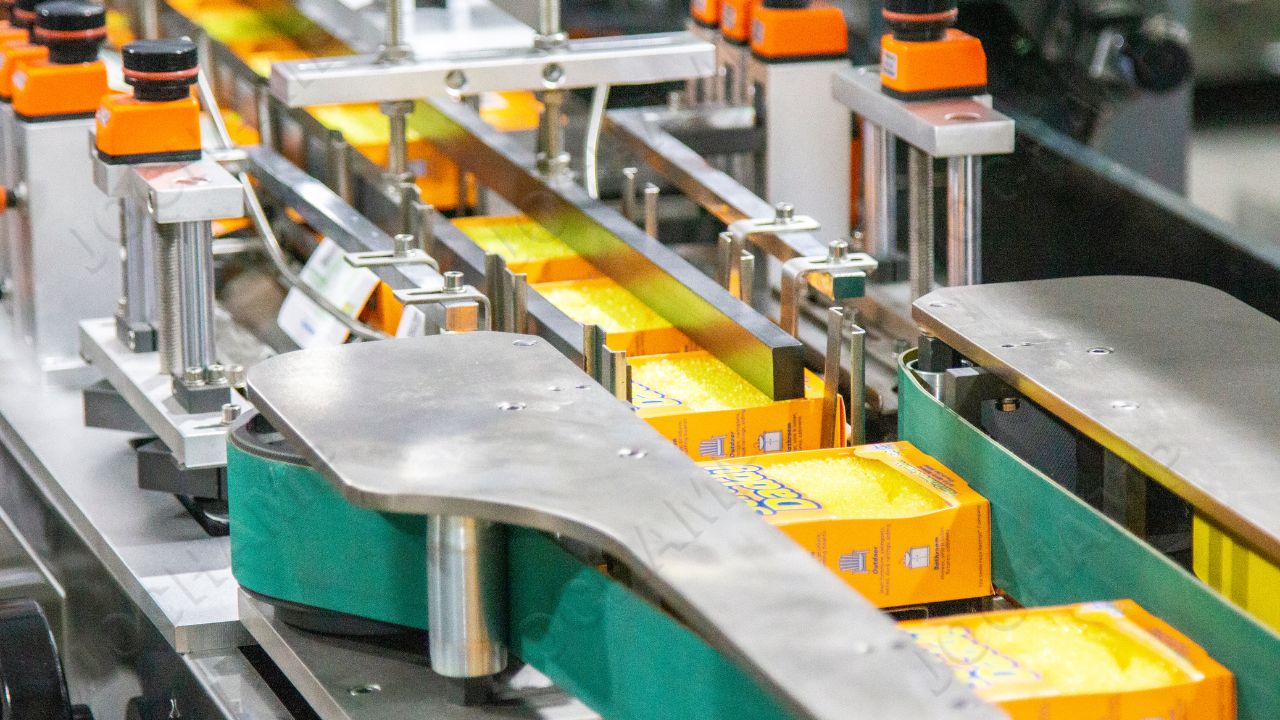
Packaging is a critical regulatory requirement across nearly every industry, besides being a vital marketing tool. That is why choosing the right type of cartoner is a strategic and critical decision for any business.
Whether you are handling delicate vials, electronics, medicine, or food products, this guide explores the most common machines, their working principles and practical applications.
What is a Cartoning Machine?

A cartoning machine, which is also called a cartoner, is a specially engineered packaging system that transforms blank cardboard into 3-dimensional boxes. Apart from forming the boxes, this machine automatically fills them with products, seals and prints useful information on their surfaces.
With the dynamic needs in the industry, these machines come in many configurations to meet the specialized packaging requirements. Among the most common types of machines are:
Horizontal Cartoning Machines
A horizontal cartoning machine, also known as a side-load cartoner, is a packaging system that inserts products into the carton from its side. Cartons are usually formed and opened while moving along a horizontal conveyor, as products are inserted into the cartons from the side rather than the top.
Most horizontal cartoners are designed for high-speed packaging, with the ability to handle over 400 cartons per minute.
Therefore, as the machine feeds, forms, erects, and opens the cartons on its conveyor system, it automatically inserts products ready for sealing. Remember, you can feed products manually, after which the cartoner automatically aligns and feeds to the matching box sizes.
Types of Horizontal Cartoners
Continuous Cartoning Machines
Continuous cartoning machines feature an uninterrupted movement. That is, they work continuously without stopping at different stages or stations.
They keep cartons and products moving continuously through the entire packaging cycle, hence they are popular for their high-speed production.
In these packing machines, cartons are erected and moved steadily as products are inserted by a closed-loop motion control mechanism into the boxes. Remember, both products and cartons move at a synchronized speed and time for accurate packaging.
By the end of this process, the cartons are finally closed and discharged in the same continuous cycle.
Common Applications:
- High volume pharmaceutical blister packaging cartoning lines
- Multipack food products like bars, sachets, and stick packs
- Multi-item carton kits like toothpaste and toothbrushes, skin care bundles
Advantages:

- Reduces labor cost per carton since products are packed in less time
- Can handle large contracts without the need for extra labor, since this is a high-speed packaging machine
- It integrates easily with other machines in the production line, like high-speed fillers, wrappers, and case packers, to give you a fully automated system
Limitations:
- Depends mainly on perfect timing between product and carton movement, which can cause irregular product feeding
- Requires skilled operators and technicians since it relies on precise synchronization and advanced servo systems
- They are optimized for standardized, repetitive production, and thus cannot handle product variation
Intermittent Motion Cartoning Machines
This packaging system operates by stopping at each stage to perform different tasks before proceeding within the production line. Usually, cartons are picked, opened, and held in a fixed position as products are inserted. Flaps are then folded and sealed before the system indexes to the next stage.
Applications:
- Irregular product packaging like glass vials, ampoules, or soft cosmetic tubes
- Operations that require frequent changeovers, such as short production runs
- In complex kit assemblies such as medical kits with different items
- High-value product productions like medical devices and small batch nutraceuticals
Advantages:
- Its stop-and-go style reduces misalignment and rejects, thereby it ensures accurate product placement
- Has a lower upfront cost because of its reduced installation complexity
- It has a lower maintenance cost and less dependence on highly specialized technicians
- Because the machine pauses, errors are easier to detect as misfeeds can be corrected before sealing
Limitations:
- Limits your ability to scale without reinvesting because of its lower throughput
- Higher mechanical wear from repeated motion over time due to frequent acceleration and deceleration
- Its systems simply can’t match high-speed packagingdemands
- It may slow down faster upstream equipment, creating mismatched speeds across your production line
Vertical Cartoner
Vertical cartoning machines are specifically designed for products that naturally drop, settle, or flow downward. In most cases, the carton either remains stationary or moves vertically while products are loaded from the top, often through funnels or chutes.
Using a top-load cartoner configuration, the machine forms, fills, and seals cartons in an upright position, using gravity-fed packaging to align products in place.
Flat cartons are often immediately positioned upright and held in pockets to maintain stability. Products are then dropped into the cartons from the top in a controlled manner.
After dropping, they settle naturally inside the cartons or might be guided by vibration systems or internal flaps. The top flaps are then folded and sealed as the cartons are moved to discharge.
Applications:

- Packaging free-flowing materials production line, i.e., sugar cubes and granules production
- Works well with powdered products and dosing systems
- Small unit pharmaceutical industries
Advantages:
- Does not require complex insertion mechanisms since products are dropped into cartons instead of being pushed
- Since it’s a top-load cartoner, products naturally settle into cartons without the need for precise orientation
- Has good integration with dosing and filling systems
- Offers consistent performance for standardized products
Limitations:
- Rely heavily on gravity-fed packaging,thereby limiting irregular, sticky, or bulky items
- Products are not precisely guided during the insertion stage, making them ineligible for systems where alignment is critical
- Lower flexibility for complex packaging
Semi-automatic Cartoning Machine
This is a machine that requires mechanical assistance and human input at key points in its production line. It uses operator input for loading while relying on machinery to assist with carton handling and closure.
The machine assists in opening the carton as an operator manually loads products into the carton. The machine holds the cartons firmly in place, ensuring it remains stable during the loading session.
Once loading is done, the machine folds the cartons’ flaps, seals and then pushes them for discharge to a collection area.
Applications:
- Small batch and custom productions like prototypes
- Startups, businesses, and emerging manufacturing units
- Production line where frequent changeover is required
- In production lines where products require quality control during loading
Advantages:
- Has lower installation and setup costs
- Handles multiple carton sizes and product types
- Easy to switch between SKUs without complex reconfiguration
- Require minimal technical expertise
- Can handle irregular or delicate items carefully
Limitations:
- Cannot support high-speed packagingdemands since output is directly tied to human operators
- Requires constant operator involvement for loading
- Quality depends heavily on the operator’s discipline and training; therefore, there can be variation in placement accuracy
- Cannot handle continuous and high-volume production efficiently
Fully Automatic Cartoning Machine

A fully automatic cartoning machine works on a continuous production line, handling high volumes of products without any human intervention. For these packaging machines, blank flat cartons are usually stored in the machine’s magazine. The machine uses its mechanical arm to pick, open, and erect the cartons.
It automatically loads products into the cartons using pushers and robotic mechanisms. After loading, carton flaps are folded using mechanical guides, and sealing is done by compression units to ensure proper sealing. Finished cartons are discharged onto an output conveyor to the collection area.
Applications:
- Large-scale pharmaceutical production
- High-volume fast-moving consumer goods
- Continuous production manufacturing lines, like beverage bottling
Advantages:
- Capable of continuous operation with synchronized motion leading to high throughput
- Requires only monitoring and occasional supervision, reducing dependency on manual operators
- High repeatability, reducing defects and improving product presentation
- Integrates seamlessly into production lines, enabling a fully automated packaging ecosystem
Limitations:
- High initial investment in installation, commissioning, and integration
- Requires high production volume to be economical
- Not flexible for production lines that require frequent changeovers
- Requires skilled technicians for setup, calibration, and troubleshooting
Specialized Cartoning Machines
Wrap-around Cartoners
A wrap-around cartoner is an automated packaging machine that wraps a sheet or layer around a product, then secures it into a compact package. Flat cartons are usually fed from the machine’s magazine, then picked and positioned on a forming station. Products are then grouped into an arrangement and aligned on a conveyor.
The flat blanks are then placed around the grouped products as the mechanical guides of the machine lift the sides of the blanks. The carton begins to wrap around the product from the sides and base, and then sealing is done using glue.
Next, the wrapped carton passes through a compression chamber for proper bonding of the adhesive. Finally, the wrapped carton is then discharged onto an output conveyor for collection.
Applications:

- Tray-style packaging for food products such as yoghurt cups
- Multipack beverage packaging, i.e., soft drink cans
- Cost-optimized cartoning operations
Advantages:
- Uses flat blanks that are tightly formed around the product, eliminating excess void space
- Integrates easily into high-speed packaginglines that create consistent output at scale
- Cartons are wrapped directly around the product, which reduces damage during transportation
- Perfect for bundling products without needing additional packaging layers
Limitations:
- Requires products to be uniform and of the same shape and size
- Wrapping process applies pressure and movement around the product, making it not suitable for fragile products
- Requires precise product grouping
- Not suitable for products requiring a specific layered arrangement
Carton Closure Technique
· Tuck-in
This is a carton sealing method where the flaps of a carton are usually folded and locked into place without using adhesive. The carton is erected and loaded with the product, with the side flaps remaining open before closing.
Smaller inner flaps are folded inward as the main flap is pushed downwards. A tuck tab on the flap is inserted between the carton walls as the tabs lock due to friction.
· Hot Melt Glue
Hot melt glue is usually heated and then applied in molten form to carton flaps. Cartons are always loaded with products and then erected. Solid pellets are then melted at 180 degrees in a tank, then applied to the flaps of the carton, and finally folded immediately. The glue cools rapidly, forming a strong bond.
· Tape/Staple
After the carton is loaded with product, its flaps are folded, and tape is applied manually to the carton.
Next, pressure is applied to the cartons, ensuring adhesion. With staple closure, carton flaps are aligned as a stapling device drives metal staples through the flaps. They are then physically locked together.
Factors to Consider when Choosing a Cartoner
Product Type

Define your product type precisely, then match it to the type of cartoner you want. At the same time, you should check the feeding options and match them with your product type. Also, remember to factor in product variability as you do a reality check on your product consistency.
Carton Sizes
Carton sizes affect machine architecture, speed, changeover time, material waste, and long-term scalability. Standardize carton sizes and designs as much as possible to maximize machine efficiency. Choose a machine that fits your SKU profile, and it balances flexibility with speed.
Tooling System
The tooling system will determine whether your machine will run smoothly or not. Define your SKU and evaluate the changeover frequency. Also, assess if your team can handle complex adjustments.
Speed Requirements
Match the cartoner’s speed to your production demand, keeping in mind the sustained and maximum speed of the machine.
Level of Automation
Match automation to your production volume since product consistency determines automation feasibility. You can choose semi-automatic or fully automatic cartoners.
After Sales Service
You must buy cartoning machines from reputable factories that offer after-sales services. These should include training, installation, and commissioning where possible.
By partnering with such factories, you will have access to replacement parts at competitive prices.
FAQ
What is the difference between a cartoner and a case packer?
| Cartoner | Case Packer |
| Pack products into cartons | They pack products into shipping cases. |
| Handles product individually or in small groups | Handles multiple carton products or bulk groupings |
| Its output is small retail – ready boxes | Its output is large transport boxes |
| Closure method is often tuck-in or hot-melt glue | Closure is often tape, hot melt glue, or strapping. |
How do you increase carton packing machine efficiency?

By fixing your product efficiency and optimizing the feeding system. Additionally, you should also reduce the changeover time and improve tooling accuracy.
Can one machine handle different carton sizes?
Yes. One machine can handle different carton sizes if designed for multi-format capability.
What is a leaflet inserter in cartoning machines?
A leaflet inserter is a module that automatically feeds a cartoning machine with instructions and information leaflets before sealing.
Partner with Neocarton
Neocarton designs and manufactures different cartoning machines, from semi-automatic to fully automatic systems. Our machines are engineered to match the dynamic packaging needs of different industries.
Additionally, Neocarton team offers free training, installation, and spare parts at discounted prices to all customers – Contact our sales team now.