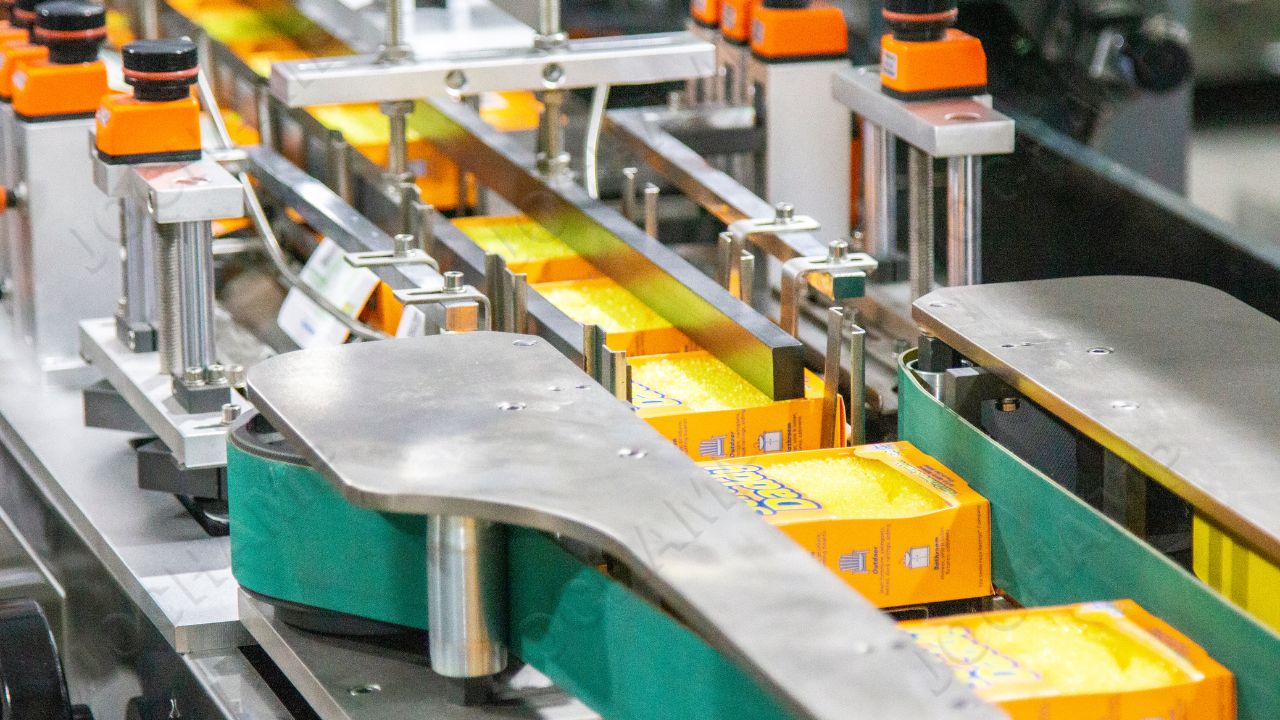
In the packaging industry, every business strives to invest in machines that can guarantee a high return on investment (ROI), whether in the long term or the short term. For cartoning machines, you have the options of going for either servo or mechanical cartoners.
In this article, we will give a balanced evaluation of the two technologies and the circumstances under which they can guarantee profitability for any business.
Quick Comparison between Servo Cartoners and Mechanical Cartoners
As the name suggests, mechanical cartoners rely on mechanical mechanisms to execute the cartoning process. These packaging machines use a series of gears, shafts, and cams to control the cartoning process.
On the other hand, servo cartoning machines use servo motors to control the motion of the packaging process. These secondary packaging machines majorly rely on programmed movements.
Below is a table comparing the two technologies:
| Features | Servo Cartoners | Mechanical Cartoners |
| Initial investment | · High initial cost | · Low initial cost |
| Diagnosing fault | · Easier due to the electronics an automated system | · Slow since most systems are mechanical |
| Changeover time | · Fast since most processes are automated (you can achieve this using a push-button) | · Slow since you have to change systems mechanically |
| Cartoning flexibility | · High | · Limited |
| Energy efficiency | · High since it uses power on demand | · Moderate |
| Precision | · ± 0.1mm to 0.2mm | · ± 1.0mm to 2.0mm |
| Noise level | · Quiet operation | · Loud due to gear systems |
Performance Factors Determining Cartoner ROI
With the many types of cartoning machines, every business is striving to choose packaging solutions that can guarantee higher ROI. Remember, you can choose either horizontal cartoners or vertical cartoners, depending on your production goals.
Among the key variables that determine whether your cartoner can deliver better ROI include:
· Flexibility and Changeover Time
First, you must be clear about the scope of your production. For instance, if your production line is designed for high-volume single-size runs, then a mechanical cartoner can be an option.
However, for multi-products that require changing carton sizes and configurations, choosing a servo-driven cartoning machine will be the best option.
In short, servo cartons are known for a high degree of flexibility when you want to change between different carton formats and sizes. You will find that most of these machines have touchscreen panels where you can configure the necessary adjustments.
Therefore, this will significantly reduce the time you require for changeover and labor costs, especially for short production runs. In the long run, this will increase the chances of a higher ROI.
Therefore, in terms of flexibility and changeover times, the servo systems win.
· Cartoning Speed and Accuracy
In the modern packaging industry, many businesses face the challenge of attaining higher throughput without compromising accuracy.
Under most circumstances, mechanical systems can be engineered to match the production capacity of servo machines.
However, the servo cartoning machines win in accuracy and precision. These machines guarantee a smooth and consistent cartoning process. Therefore, you will rarely experience any instances of product damage, which again helps your company realize maximum profits.
· Cartoner Machine Maintenance
Servo cartoning machines have fewer moving parts, and they have low maintenance in the long-term. Of course, the few moving parts also imply these machines have few points of failure, and you will not require constant lubrication.
However, in case of a breakdown due to the electronic components, you require specialized technicians. Still, it might guarantee higher ROI in the long-term.
On the other hand, mechanical cartoners have a simple structure and design that is easier to maintain. You don’t need software engineers to troubleshoot and fix the machine.
That is, their rugged design makes it easier to maintain the machines with basic mechanical skills, which may reduce the cost of operating the machines.
However, the numerous moving parts cause wear and tear, which may reduce the cartoners’ accuracy and precision in the long-run.
Therefore, for maintenance, it varies with the circumstances at hand.
· Energy Efficiency
Modern servo machines have been optimized to use less energy. This is due to precise motion control, where the machines use power on a demand basis, thanks to their variable frequency drive systems.
This alone can contribute to significant energy savings, which ultimately helps in getting higher returns.
On the other hand, the energy efficiency in the mechanical cartoners can be classified as moderate. This is because you cannot control the entire operation electronically.
You can calculate the return on investment (ROI) of cartoning machines by:

Remember, the net gain here includes both savings and revenue generated by the machine.
When it comes to initial investment, mechanical cartoners are more affordable that servo driven cartoning machines.
However, for long-term operational costs, which are an important component of the ROI calculation, servo cartoners win. That is, you will save money due to lower wastages, reduced downtime, and fast changeovers.
Again, with regards to scalability and dynamic production environments, the servo cartoners outperform the mechanical cartoners.
Therefore, if you are looking for machines that guarantee higher ROI in the modern-day dynamic packaging environments, then servo-driven machines offer a better option.
Which Cartoners wins in Terms of ROI?
The type of products you package will determine which machine offers higher ROI. Analyzing all possible scenarios, you will get a higher ROI in:
- Mechanical cartoners, when you package cartons of the same size (dimensions), say for one or two months at a time. Remember, under such circumstances, the machine will pay for itself within a short period of time since it has lower upfront costs.
- Servo cartoners, when you keep changing box sizes frequently, maybe on a daily or weekly basis. It offers a highly flexible environment for scalability and business growth. In most cases, these machines pay for themselves within 1 to 2 years.
In short, it is important to analyze your production needs to determine whether a cartoning machine meets your unique production needs or not.
FAQs
1. Are there cartoners that combine both mechanical and servo technologies?
Yes, there are hybrid machines where the manufacturers use mechanical drives and servo drive systems.
2. Is the higher initial cost of servo cartoners worth it?
Yes.
Once you analyze your packaging needs, within 1 to 2 years, you will recover the money you invested in the machine.
3. How fast is the changeover time in servo cartoners?
In most cases, it takes about 2 to 5 minutes once the machine has been configured.
Partner with Neocarton
Neocarton is a professional cartoning machine manufacturer in China. Our range of products includes mechanical cartoners, servo cartoners, horizontal cartoners, and vertical cartoners, among other custom models.
We offer complete turnkey solutions in the cartoning industry, with easy-to-integrate solutions for seamless packaging – Get a quote now.