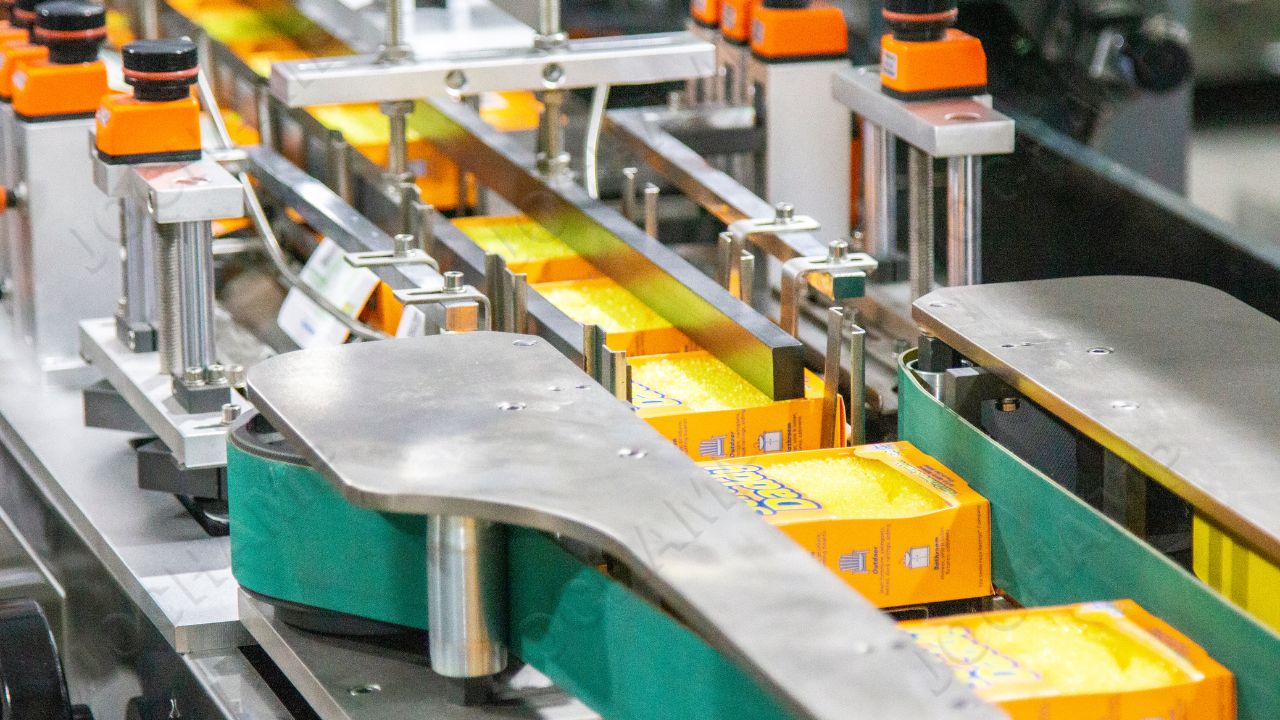
Automated packaging of soap increases overall effectiveness, lowers cost through reduced labor, and creates a consistent presentation of your product. Soap cartoning machines can create fast, accurate, and dependable packaging.
This will protect your product through the various stages of handling, storage, and transportation around the globe, into and out of various markets or applications.
Let’s start with the basics:
Understanding Soap Cartoning Machines

The soap cartoning machine is an automated packaging equipment that forms cartons, inserts soap products into the cartons, and seals them for distribution. A soap cartoning machine can package bar soap and wrapped soap while providing accuracy, speed, and consistency.
Using a soap cartoning machine improves the efficiency of your packaging operations and reduces human error associated with manual packaging processes. This will increase your speed of production and ensure that you are producing uniform cartons throughout your entire production process, despite having little or no human involvement.
Additionally, the same soap cartoning machine can be used for personal care products, hospitality, and pharmaceutical products, where the need for hygiene, uniformity, and protection of the product is very important.
Types of Soap Cartoning Machines
· Horizontal Soap Cartoning Machines
You utilize horizontal cartoners to load soap products from one side of the cartoner. They accommodate wrapped bar soaps and multipacks as well as those requiring precise placement during the loading process.
These machines will provide stability during product handling and maintain product alignment throughout the process. Horizontal cartoners are suitable for high-speed production lines where accuracy and consistency are paramount.
· Vertical Soap Cartoning Machines
You use vertical cartoners to load soap from the top of the packaging. Vertical cartoners depend on gravity to load soap products into a carton.
Vertical cartoners can accommodate loose, stacked, or unwrapped soap products. They are best suited to simpler packaging arrangements where high precision is not a necessity. A vertical cartoner may be the best choice for handling lightweight or free-running soap products in a medium-volume production environment.
· Semi-automatic Soap Cartoners
You utilize semi-automatic cartoning systems when you are only requiring manual assistance. The operator has to load the products manually, while the machine does all the work of forming and sealing cartons.
These machines are designed to meet the needs of smaller productions or companies requiring flexibility in their production process. You can easily adjust these machines to accommodate multiple product sizes with very little complexity. You can also significantly reduce the initial investment while still maintaining acceptable levels of productivity.
· Fully Automatic Soap Cartoning Machines
If you need a cartoner to handle your high-volume production operations, then choose a fully automatic cartoner that is able to perform all functions with little to no human participation (i.e., carton forming, product insertion, and sealing).
Because of their ability to reduce labor requirements and improve overall production efficiency, you can expect a consistent output, high speed, and minimal downtime in a large-volume production environment.
Key Components of a Soap Cartoning Machine
· Carton Magazine

You will keep your flat cartons in a carton magazine, which is fed into the forming section by automatic machinery. Therefore, the carton magazine provides a constant supply of cartons during production to maintain continuous production runs.
· Product Feeding System
The product feeding system guides soap products into the machine. It guarantees good alignment and consistent feeding into the cartons.
· Carton Forming Unit
The carton forming unit opens and forms flat cartons into their finished box shape and prepares them for product insertion.
· Insertion System
You insert the soap products into the formed cartons using the insertion device. The insertion device accurately positions and prevents damage to the soap products.
· Closing and Sealing Unit
This unit will close carton flaps and seal them so that the packaged soap will stay together while being transported and handled. You can use your desired sealing method, like tuck-in or hot-melt glue, based on your packaging needs.
· Control System (PLC and HMI)
You will control the machine’s operation with a PLC (Programmable Logic Controller) and Human-Machine Interface (HMI), so you can change program settings, monitor machine’s performance, and track faults.
· Conveyor System
The Conveyor moves cartons and product through various machine stages, providing for continuous, effective operation of the machine’s systems.
· Pusher Arm
The shape of the pusher arm provides a precise means of inserting soap products into the cartons to eliminate potential misalignment or soap product damage.
Step-by-step Working Process of a Soap Cartoning Machine
· Carton Loading

Load flat cartons into the magazine. They will be transported into the processing system by the machine automatically. This will provide a continuous supply of cartons, and there will be no disruptions in production.
· Carton Forming
The machine opens and forms cartons into final boxes for the purpose of inserting products into the boxes. Before product insertion, this step will ensure that the boxes are structurally solid and shaped properly for filling.
· Soap Feeding
You place the soap products into the system through the feeding unit of the machine. The machine will then align the product with the correct position within the carton. Performing this step will minimize errors during product insertion and improve efficiency in packaging.
· Product Insertion
Using a pusher mechanism, the soap is inserted into the formed carton. It will position the soap correctly in the box while eliminating the chance of damage to the product during insertion.
· Carton Closing/Sealing
The carton flaps are then securely closed and sealed by the machine. This protects your product while ensuring the package is kept intact throughout transport and handling.
· Discharge
After a carton is finished, it is released onto a conveyor for transport to secondary packaging, storage, or distribution.
Choosing the Right Soap Cartoners
When choosing a soap carton packaging machine consider these factors:
· Cartoning Speed
You need to select a machine that meets or exceeds your desired production needs. Carton production speed can vary widely based on the level of automation and overall design of the machine. The fastest carton production speed model can be more than 300 cartons per minute.
Choose a model that has a slightly faster carton production speed than what you require, so you will have additional capacity for producing cartons at higher volumes in the future.
· Material Compatibility
You will want to make sure your equipment is configured correctly for the carton material you will be using. Depending on the carton material, you will need to have compatible machine forming and sealing systems so that the packaging maintains its quality. An incompatible forming and sealing system would create problems such as weak seals, damaged cartons, or production inefficiencies.
· Carton Size
Make sure you select a machine that will accommodate the carton sizes you require. Flexibility will be beneficial if you process varying-sized products.
· Servo Driven Technology

You need to consider servo-driven systems as they provide high-quality precision control and operational smoothness. They also improve operator accuracy, reduce mechanical vibration/interference, and increase overall machine capability. In addition, they improve repeatability and reduce wear on mechanical parts over long periods.
· Quick Changeover
You require machinery that allows for rapid changes in size between different products, decreases downtime, and increases productivity in multi-product operations.
· Automatic Fault Detection and Rejection
Choose machines equipped with automatic fault detection systems to identify defects and remove defective cartons from production line to help maintain quality standards.
· Integration with Upstream Soap Making Machine
To maximize the benefits of a cartoner, you should ensure that your cartoner fits properly with your soap manufacturing machines. Seamless integration assists with maximizing workflow efficiency.
· Quality Compliance
Confirm your machine’s conformance to the industry standards for safety and hygiene. This will guarantee the consistency of your product’s quality.
· Machine Brand and Cost
Select a dependable machine manufacturer who will provide you with a durable machine and good technical assistance. Consider the initial cost of your machine versus its long-term performance and maintenance requirements.
· Automation and Integration of IoT
The performance of your machine can be increased if you select one with IoT integration. An IoT integrated system allows for real-time monitoring, predictive maintenance, and tracking of system data.
· Ease of Operation and Maintenance
Choose a machine that’s simple to operate and has a user-friendly interface. Simple maintenance decreases machine downtime and maximizes long-term efficiency.
FAQs
1. What speed can a soap cartoning machine achieve?
Depending upon the type of machine you use and the level of automation, cartoning machines can run at a speed of 30 – 300 or more cartons per minute.
2. Can one machine handle different soap sizes?
Yes, if you choose to purchase a cartoning machine with adjustable settings and fast changeover times from one size of soap to another, the machine can handle multiple sizes.
3. What is the lifespan of a cartoning machine?
It will depend upon your maintenance and frequency of service, but generally, the carton machine will last from 10 – 20 years.
4. What is the best material for soap cartoning?
The type of soap cartoning material you choose will depend on what is important to you, like product protection and sustainability. In general, Kraft paperboard, and some types of cardboard will provide you with a good balance of all these factors, such as strength, recyclability, and high-quality printability.
5. How frequently should you maintain soap cartoners?

You should conduct routine maintenance on your soap cartoners on a daily basis. In addition, it is recommended that you conduct scheduled inspections at least weekly and monthly to guarantee excellent performance.
Partner with Neocarton
If you are looking for a reliable, high-performance soap cartoning machine to meet your production needs, look no further than Neocarton. With our durable machines and advanced automation capabilities, along with customizable solutions and great technical support, we will assist you in achieving an efficient and consistent packaging process within your production line.